 » Study » Potential student research projects » Available student project - Electrically Injected Bottom-Up Micro-Cavity Lasers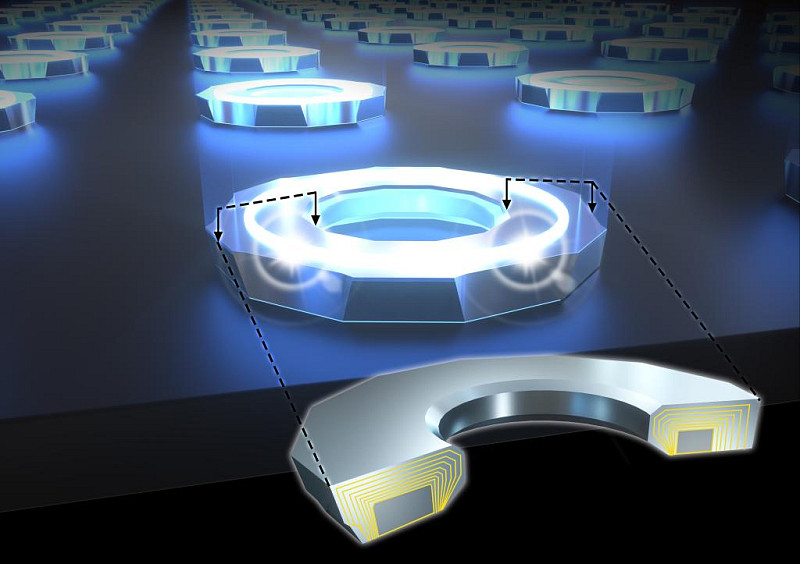
Bottom-up fabrication of laser cavities via epitaxial growth is a compelling alternative to conventional top-down methods, offering micro- and nanolasers with ultra-low optical losses. By avoiding etching-induced roughness, this approach produces atomically smooth crystal facets and high-quality optical confinement at the nanoscale.
This project aims to demonstrate electrically injected lasing in InP/InAsP multi-quantum well micro-ring cavities, realized through selective area epitaxy. The platform combines the precision of epitaxial growth with the scalability of on-chip integration, addressing a key challenge in advancing bottom-up nanolasers to practical device architectures.
The resulting microcavity lasers promise wide-ranging applications in telecommunications, precision sensing, and as compact light sources for next-generation photonic integrated circuits. By enabling electrically driven operation in epitaxially grown nanocavities, this work will lay the foundation for robust, scalable, and energy-efficient nanoscale light sources that can transform integrated nanophotonics.

 Menu
Menu
 Search


