 » Study » Potential student research projects » Available student project - Nanofluidic Processing of Biological Samples for Single-Molecule Detection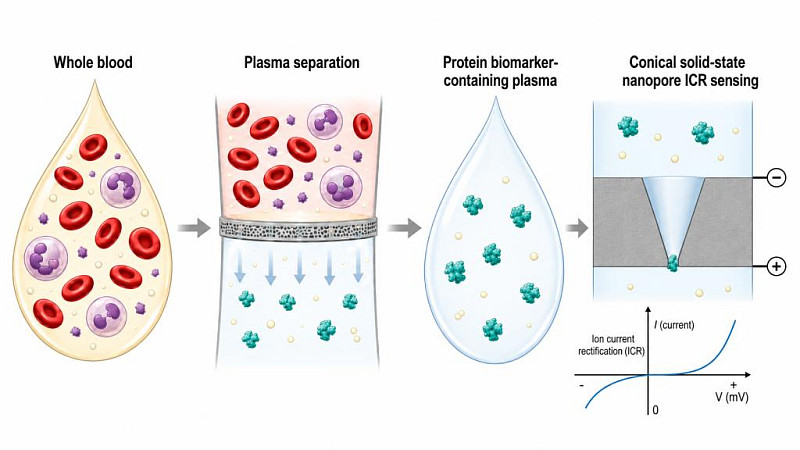
Solid-state nanopores can detect disease biomarkers with exceptional sensitivity, but translating biosensing from carefully prepared laboratory samples to complex biological fluids remains a major challenge. Blood, for example, contains cells, proteins, salts and many other components spanning an enormous range of concentrations and sizes. Before low-abundance molecules can be reliably analysed using a nanopore sensor, the sample must therefore be processed in a controlled and efficient manner.
This project will investigate micro- and nanofluidic approaches for preparing and purifying biological samples prior to solid-state nanopore sensing. The aim is to develop compact fluidic platforms capable of separating or enriching selected components of complex samples while remaining compatible with downstream electrical nanopore measurements.
Depending on the project level, students may work on the design and fabrication of fluidic devices, investigate transport through micro- and nanoscale channels and membranes, study size- or charge-dependent molecular separation, perform numerical simulations of fluid and ionic transport, or integrate sample-processing components with nanopore sensing systems.
The project provides an opportunity to work at the interface of physics, engineering, nanotechnology and biosensing while contributing towards future integrated platforms for rapid analysis of complex biological samples.
An interest in experimental physics, nanotechnology, fluid mechanics, materials science, engineering or interdisciplinary research.

 Menu
Menu
 Search


