 » Study » Potential student research projects » Available student project - Quantum Communication for Secure and Anonymous Voting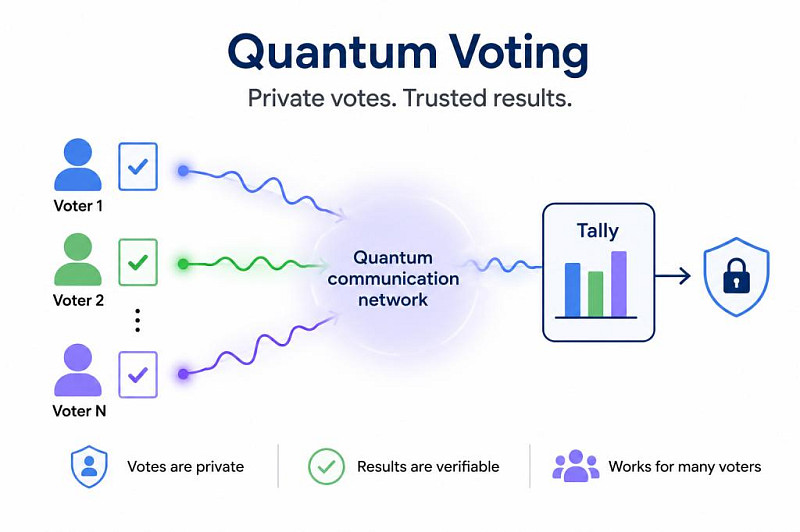
Voting presents a fundamental information-security challenge: votes must be transmitted and counted reliably while preserving the privacy of individual voters. Quantum communication offers new possibilities for addressing these requirements by using the physical properties of quantum systems to protect information.
This project explores how quantum states of light can be used to develop secure and anonymous voting protocols. Of particular interest are continuous-variable quantum systems based on squeezed light, which can generate and distribute quantum correlations between participants using optical communication networks.
Students will investigate how these quantum resources can be combined with classical information processing to transmit votes, preserve voter privacy and enable reliable recovery of voting results. The project may also explore broader questions such as how a voting protocol can be verified, how it responds to optical loss and noise, and how security changes when multiple participants or potentially untrusted parties are involved. These are central issues in quantum voting; the underlying research considers properties including privacy, verifiability and robustness.
Depending on the student’s interests, the project may involve theoretical modelling, numerical simulation, information theory, quantum communication protocols, or experimental concepts involving squeezed light and optical detection.
The project provides an opportunity to explore the intersection of quantum physics, communication and information security through the concrete problem of secure voting.

 Menu
Menu
 Search


