 » Study » Potential student research projects » Available student project - Simulation of radiation in large complex environments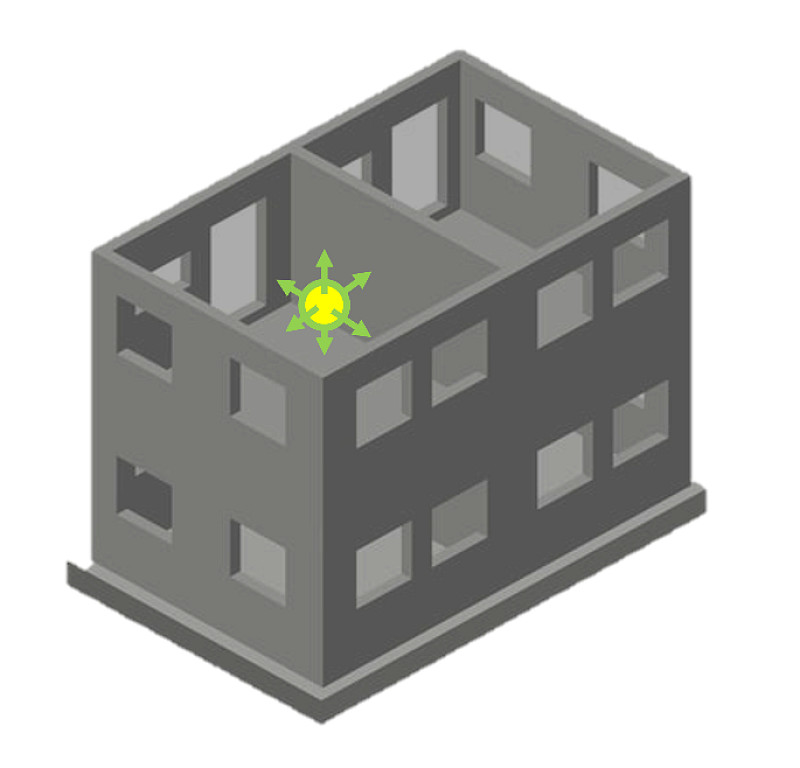
Radiation simulations help us understand sub-atomic particles behave in various environments. They are critical to many aspects of the nuclear and radiation industry, such as the design and safe operation of medical radiation facilities, nuclear reactors and research facilities.
Currently, the industry standard method for radiation simulation is the Monte Carlo approach. While accurate, the Monte Carlo is computationally intensive and simulations quickly become intractable at the scale of buildings or small city blocks. Simulations on such a large scale are particularly valuable in boarder security, emergency response and preparedness, national security and Defence. In these applications, accelerated simulation allows an analyst to determine the location and nature of real or hypothetical radiation sources in a responsive manner that keeps pace with critical decision making. Alternatively, accelerated simulation allows the automated optimization of radiation shielding in large infrastructure projects, such as medical radiation and research facilities.
Machine learning has some precedent in application to radiation simulations. However, a key limitation of applications thus far is a lack of generalisation to diverse geometries. The aim of the proposed project is to develop a new method of radiation simulation that is accelerated by machine learning and applicable to arbitrary environments without specific re-training. This will make previously intractable problems accessible to everyday radiation professionals.
The project may involve:

 Menu
Menu
 Search


