 » News & Events » Physics news » Honours student James Monro wins Thomas H Laby medal for best thesis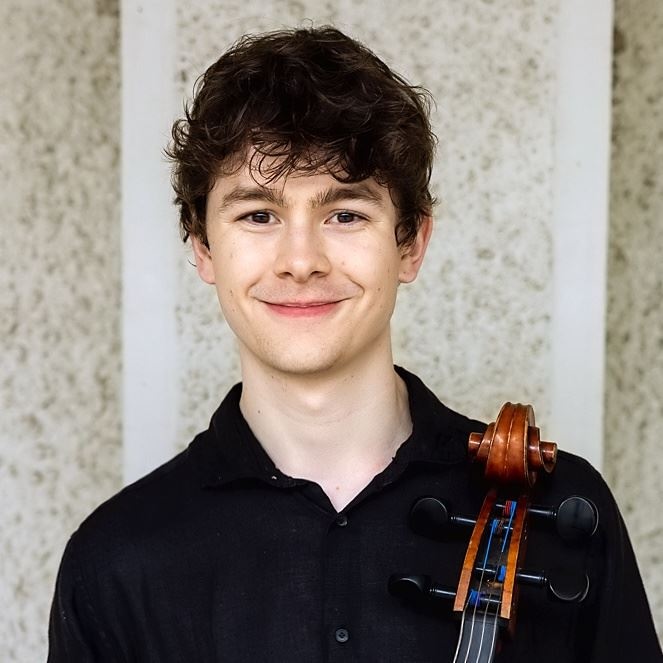
ANU student James Monro has won Thomas H Laby medal for the best Honours or Masters thesis from an Australian University, awarded by the Australian Institute of Physics (AIP).
Mr Monro’s honours thesis was entitled Searching for Axion-Like Particles with Perturbed Alkali-Noble Comagnetometers.
“Receiving the medal feels surreal. A thesis, much like a novel, speaks differently to everyone and it is a gamble to try to anticipate what will excite an anonymous referee,” said Mr Monro, whose research was conducted in the Department of Quantum Sciences and Technology (DQST).
“A little indulgently, I just tried to write the kind of thing I personally would want to read, so I feel lucky that the referees shared my taste!”
It’s the fifth time that an ANU student has won in the nine-year history of the national medal, which was established in 2018 to commemorate Thomas H. Laby.
Two awards were made in 2026, with George Sanamyan of the University of Adelaide also receiving the medal.
Mr Monro’s research explored searching for axions – hypothetical particles that have been proposed to patch various holes in the Standard Model, and are also promising candidates for cold ultra-light dark matter. The thesis evaluated looking for axion, and axion-like particle (ALP) fingerprints in the behaviour of spin-polarised ensembles, as ALPs are expected to exert tiny torques on nuclear spins. If so, they could be detected indirectly using a detector called a co-magnetometer, that consists of interacting spin-polarised ensembles of alkali vapour and noble gas.
Mr Monro examined how a co-magnetometer developed by his DQST supervisors, Professor Ben Buchler and Dr Morgan Hedges, could be repurposed to probe for axions, using its dual-signal capability to enable greater rejection of troublesome magnetic noise and a deeper search for exotic physics.
He also proposed some extensions to the experimental design that would enable axion interactions to be broken down into their couplings with individual nucleons.
“One of my favourite things about this project was that I could spend lots of time at both ends of the theoretical-applied spectrum, dipping my toes into both abstract quantum field theory and experimental work,” Mr Monro said.
His supervisor, Professor Ben Buchler also praised the breadth of the approach.
“James was a joy to have as a student.
“His work spanned the deepest mysteries of physics beyond the standard model, to the finicky details of data collection from a laboratory experiment.
“It was a great achievement to synthesise both these elements into a single coherent thesis,” Professor Buchler said.
Mr Monro is keen to now do a PhD in mathematical physics.
But, as an avid cellist he intends to pursue a dual career in music performance alongside academia.
The award consists of a medal, certificate and monetary prize of $1000, and a one year membership of the AIP.
The medal will be presented to Mr Monro at the next AIP Congress in Sydney, and he will be invited to present a contributed talk related to his thesis, and write an article for publication in Australian Physics.
The award is supported by a generous bequest from the late Betty Laby, daughter of Thomas Howell Laby.


 Menu
Menu
 Search
