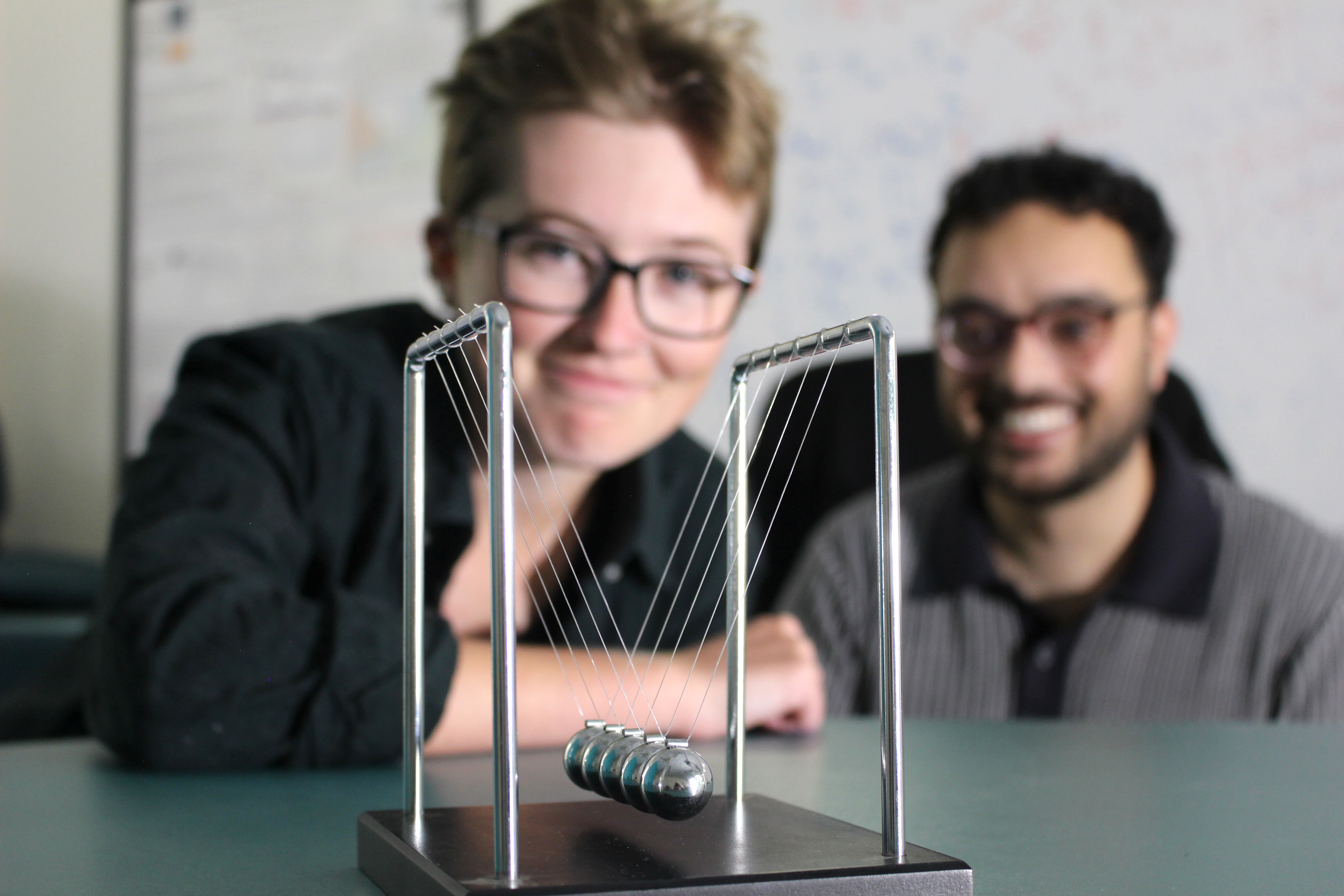
Sending quantum information through a chain of qubits, like energy through a Newton’s cradle, could be the key to faster operations, and take quantum computing to the next level.
The quantum Newton’s cradle design shows how a laser can be used to give a precisely designed kick of energy to a row of trapped ions, to quickly set them up for quantum calculations, known as gates.
The superpower of the new algorithm is its ability to rapidly entangle any two ions in the row, without affecting the ones in between: like a Newton’s cradle, the energy travels through the ions leaving them untouched.
“The trick in quantum computing is not making lots of qubits, but using them. To succeed you need the unholy trinity of gate speed, gate quality and number of qubits,” said lead author Zain Mehdi, from the Department of Quantum Sciences and Technology (DQST).
“These new fast gates break the bottlenecks – I think with its potential for scalability, there is no other approach that is currently as successful as trapped ions.”
Quantum computers promise the ability to solve problems that stymie classical computers, such as optimisation, search or factorisation problems. Many different approaches to creating the building block of a quantum computer, (a quantum bit or qubit) are competing for dominance: For example, super conducting silicon, diamond-based NV centres, quantum dots, or this work that uses ions suspended in an electromagnetic field.
Although other technologies have larger numbers of qubits, trapped ions lead the quantum computing race as measured by a metric known as quantum volume. The current record quantum volume is held by the company Quantinuum, for their combination of large number of qubits, that hold their data (coherence time) and have low noise connections to perform operations (known as gates): these are the crucial ingredients for successful quantum calculations.
The new ANU design adds another advantage to trapped ions’ capabilities: the laser system can quickly address and entangle any arbitrary pair of ions, allowing maximum flexibility for quantum calculations.
The design is published in Physical Review A, and has also attracted linkage funding with IonQ, a United States-based company who build trapped ion quantum computers.
Trapped ion quantum computers use single ions in electrostatic traps as qubits, which are stable for weeks or more. They are kept in a vacuum and are laser cooled, so do not need cryogenic temperatures. The qubits are addressed with exquisite control using lasers, which Dr Mehdi points out “are the technology we have the best control over.”
The new flexible and fast gate method is a critical component needed to make effective large scale quantum computers from trapped ions, said group leader Professor Joe Hope from DQST.
“Existing gates operate in an adiabatic regime that is slow; but there was no physics reason stopping us from going fast.”
“Now we have switched to a different parameter regime, we have a clear shot on scaling to millions of gates on many hundreds of qubits. That would be able to do the kind of quantum simulations for successful drug design or materials design,” Professor Hope said.
The team used a machine optimisation algorithm to search for solutions that gave the output states they wanted.
Initially the team aimed for a super-fast addressing scheme, delivering laser pulses in around 100 nanoseconds, but realised it challenging to implement with current technology. So DQST honours student Isabelle Savill-Brown took on exploring more feasible, slower pulse rates, only to discover it gave better solutions.
“When exploring this regime I was able to find gate solutions between any pair of ions within the chain. This was surprising given previously we could only find solutions between ions that were right next to each other,” said Ms Savill-Brown, now PhD student, and first author on the paper.
“We initially didn’t understand why the algorithm was suddenly finding these non-nearest-neighbour solutions.
“Then we realized we had moved into a regime where there was enough time for energy to travel throughout the chain like a Newton’s cradle,” Ms Savill-Brown said.
The solutions the algorithm found solutions were between 1 and 10 microseconds – although slower, still at least two orders of magnitude faster than current adiabatic gates, said Dr Mehdi.
“We had to let go of our human intuition to find this better solution.
“You kick separate ions, and watch them wiggle – they talk via the ions in the middle. At the end of the operation you give it another kick that stops everything from moving, but the two separate ions are now entangled.”
Being faster actually leads to higher gate fidelity, modelled to be about 99.99 percent, because the operation is higher frequency than most noise sources, which range from tens of hertz to hundreds of kilohertz.
Surprisingly the speed of gate operations is unimpaired as the system is scaled to connect more gates, Ms Savill-Brown.
“It's really interesting to understand how the ion dynamics impact our gate design, and how we can use the different regimes to our advantage; it’s not just about making gates faster, but also finding the regimes that naturally support scalability.”
“A high-fidelity experimental implementation of these models would provide a clear roadmap for bridging the gap between smaller existing quantum processors and large-scale architectures.”
The team used the supercomputer at the National Computing Infrastructure for the machine design. They were surprised that their model found solutions for just about any initial conditions they could throw at it, said DQST team member Dr Simon Haine.
“If the trap is a different shape, or wobbling somehow, then the machine just finds a different solution. It just keeps working!”
The team worked closely with their partners in IonQ, who assembled a laser system to demonstrate the necessary pulse sequences.
“The most fun is the weekly exchange of ideas, where we share our detailed and rigorous modelling, and they tell us why it won’t work - until we do get something that is a real-world solution!” Dr Mehdi said.
The new quantum gate scheme will work for addressing any two in a line of thirty to forty qubits, and, unlike conventional adiabatic gates, they do not have to be all the same ions. Having different ions in the chain increases the flexibility of the device, as multiple specialised qubits can be included, each with different advantages (e.g. cooling, storage or linking). There is also a technical advantage, as different ions respond to different laser wavelengths.
“The increased gate speed and computational efficiency support deeper circuits, more effective qubit use, and higher system throughput, bringing quantum computing closer to practical scalability and real-world applications,” Professor Hope said.
Another advantage of the design is that a number of Newton’s cradles can be connected, allowing more complicated quantum problems to be tackled. Even if the ion chains are physically separated optic fibres can be used to create photonic interconnects between them.
Through the linkage grant, the partners hope to implement and improve the connections, and also to move to parallel gates – addressing two or more pairs of ions in the chain simultaneously.
“It’s very high tech and has never been built before,” Professor Hope said.
“It’s exciting to have a company wanting to build actual applications with it. It feels like a solid lottery ticket in something revolutionary.”


 Menu
Menu
 Search

