 » News & Events » Application of conical nanopores in SiO2 membranes for molecular separation and biosensing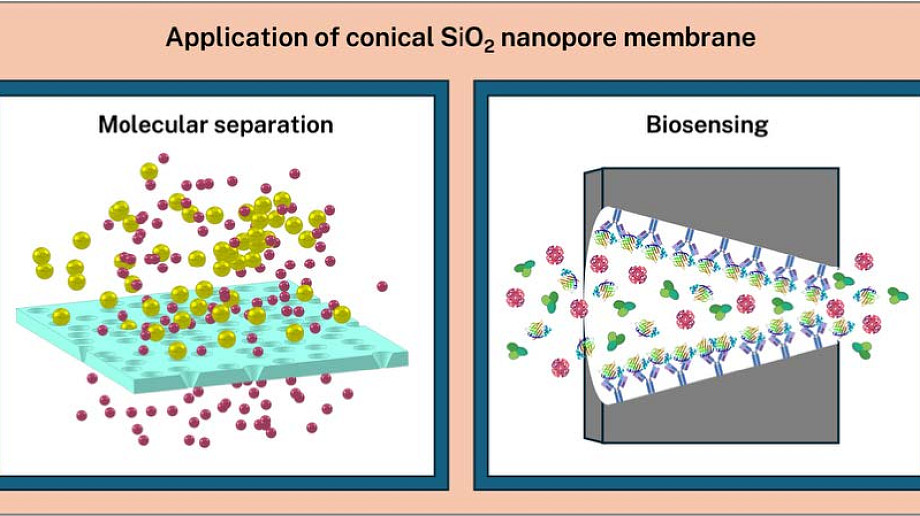
Solid-state nanopores are powerful nanofluidic systems with applications across many areas, including filtration, biosensing, drug delivery, electroosmotic pump, and osmotic power generation. This talk presents the main outcomes of my PhD research, utilising conical nanopores in silicon dioxide (SiO₂) membranes as a platform for charge-based molecular separation and ultrasensitive biosensing. Conical nanopores were fabricated using high energy ion irradiation of the membranes followed by wet chemical etching, enabling precise control over pore geometry. At the nanoscale, ion transport is governed by the surface charge and pore shape, resulting in charge selectivity that leads to ion current rectification, which is observed as a nonlinear current voltage response. This rectification behaviour provides a direct and sensitive electrical readout of electrostatic interactions within the nanopore.
Exploiting the charge selectivity of the conical SiO₂ nanopores, we established a robust charge-selective molecular separation platform. The native negatively charged membranes show up to 36-fold preferential transport of positively charged molecules, compared to negative ones. Upon aminosilane modification of the nanopore surface, the membrane charge was altered, leading to a corresponding reversal in selectivity and approximately 20-fold preferential transport of negatively charged molecules. This tunable control of membrane surface charge enabled efficient and reversible charge-based molecular separation from a mixture.
The platform was subsequently extended to develop a biosensing platform for the detection of heart-type fatty acid binding protein (H-FABP), which is an important biomarker of cardiac injury and is also emerging as a promising clinically relevant biomarker in neurodegenerative disorders. Suitable receptors on the nanopore surface enable specific molecular recognition, where target binding induces measurable shifts in the rectifying current-voltage response due to surface charge modulation. The platform achieved ultrasensitive detection in the atto-molar range with a selectivity >10⁶ against non-target proteins. Furthermore, the nanopores were regenerable, enabling repeated use of the sensing system.
Overall, this work demonstrates that conical SiO₂ nanopores provide a robust and versatile platform that bridges fundamental nanoscale ion transport with practical applications in molecular separation and ultrasensitive biosensing.
Join the Zoom Meeting
Meeting ID: 857 5212 4621
Password: 931365


 Menu
Menu
 Search


